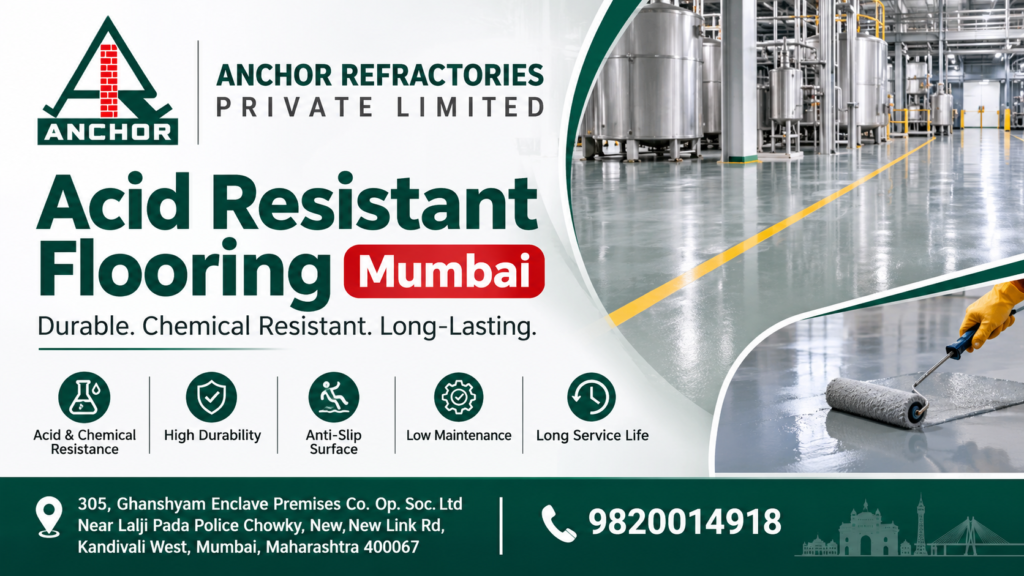
Acid Resistant Flooring Mumbai-Industrial facilities require flooring that can withstand chemical exposure, mechanical stress and demanding operating conditions. In industries where acids and corrosive substances are part of daily operations, ordinary concrete flooring may deteriorate over time. Selecting the right protective flooring system is essential for maintaining a durable, safe and efficient workplace.
Anchor Refractories Private Limited is a manufacturer and industrial consultant serving industrial flooring and protection requirements. Businesses searching for acid resistant flooring in Mumbai can benefit from understanding how specialised flooring systems protect concrete surfaces against chemical attack. Acid Resistant Flooring Mumbai
What Is Acid Resistant Flooring?
Acid resistant flooring is a specialised industrial flooring system designed to protect concrete and other substrates from damage caused by acidic substances. Depending on the chemical exposure, the system may include acid-resistant coatings, resin flooring, protective mortars, tiles or brick linings.
Unlike conventional flooring, acid resistant flooring is selected according to the type of acid, its concentration, temperature and duration of contact. A system suitable for occasional spills may not perform adequately under continuous chemical exposure.
For Acid Resistant Flooring Mumbai, the correct flooring specification can help reduce surface deterioration, simplify cleaning and support long-term maintenance.
Why Choose Acid Resistant Flooring Mumbai for Industrial Facilities?
Mumbai has a diverse industrial landscape, including chemical processing, pharmaceutical manufacturing, engineering and industrial storage facilities. These environments may require flooring that protects concrete from corrosive substances and regular industrial activity. Acid Resistant Flooring Mumbai
1. Protection Against Chemical Damage
Acids can penetrate or attack unsuitable flooring materials, potentially damaging the concrete beneath the surface. Properly specified acid resistant flooring creates a protective barrier against the chemicals encountered during production, cleaning and storage.
2. Improved Industrial Safety
Chemical spills can create slippery surfaces and damage floor structures. Suitable flooring systems, combined with appropriate drainage and slip-resistant finishes, can help improve workplace safety.
3. Reduced Maintenance Requirements
A well-designed flooring system can simplify cleaning and reduce the frequency of repairs caused by chemical deterioration. This can help industrial facilities manage maintenance costs and minimise operational interruptions.
4. Long-Term Concrete Protection
Protecting the concrete substrate is important for maintaining the integrity of industrial floors. Acid resistant flooring helps prevent chemical penetration when the selected system is compatible with the operating environment and correctly installed.
Types of Acid Resistant Flooring Systems
The right flooring system depends on the chemical exposure and operating conditions. Different materials offer different levels of protection.
Acid Resistant Epoxy Flooring
Specialised epoxy flooring can provide a durable, protective surface for industrial environments exposed to selected chemicals. However, standard epoxy is not suitable for every acid or concentration.
Acid resistant epoxy systems may be considered for manufacturing areas, chemical storage zones and processing facilities where the exposure conditions are compatible with the selected formulation.
Novolac Epoxy Flooring
Novolac epoxy systems are designed for demanding chemical environments and can provide improved resistance to certain acids and solvents compared with conventional epoxy systems.
These systems may be suitable for industrial floors that experience aggressive chemical exposure. Their suitability should always be confirmed against the specific chemicals, concentrations and operating temperatures.
Vinyl Ester Flooring
Vinyl ester systems are used in specialised industrial environments requiring resistance to certain aggressive chemicals. They may be considered for chemical processing plants, pickling areas and other applications where conventional resin systems may not provide adequate protection.
Acid Resistant Tile and Brick Flooring
Acid-resistant tiles and bricks, installed using compatible bedding and jointing materials, can provide protection in demanding industrial environments.
These systems are often considered for chemical storage areas, drainage channels, containment zones and locations exposed to frequent chemical contact.
How to Select Acid Resistant Flooring Mumbai
Selecting acid resistant flooring requires a detailed understanding of the industrial environment. The following factors should be evaluated before finalising a flooring specification.
Identify the Chemicals
Prepare a list of the acids, alkalis, solvents and cleaning agents used within the facility. The flooring material must be compatible with the actual chemicals present.
Evaluate Chemical Concentration and Temperature
Chemical resistance can vary significantly depending on concentration and temperature. A flooring system that withstands a diluted acid may not be suitable for a concentrated solution or elevated operating temperature.
Assess Exposure Duration
Occasional splashes, frequent spills and continuous immersion create different levels of chemical stress. Flooring should be selected according to the expected exposure conditions.
Consider Mechanical Loads
Industrial floors may experience forklift traffic, machinery loads, abrasion and impact. Chemical resistance alone is not enough; the system must also withstand the mechanical demands of the facility.
Examine the Concrete Substrate
The condition of the existing concrete, including cracks, moisture and surface contamination, affects flooring performance. Proper assessment and preparation are essential before installation.
Installation Process for Acid Resistant Flooring
A properly installed flooring system is essential for achieving the expected chemical resistance and service life.
Step 1: Surface Preparation
The existing concrete surface is inspected and prepared by removing loose material, contamination and unsuitable coatings. Damaged concrete must be repaired before the flooring system is applied.
Step 2: Application of Primer
A compatible primer may be applied to improve adhesion between the concrete substrate and the flooring system. Primer selection depends on the substrate condition and the specified flooring materials.
Step 3: Installation of the Protective Flooring
The selected coating, mortar, tile or brick lining is installed according to the manufacturer’s technical requirements. Thickness, joint treatment and application conditions should be carefully controlled.
Step 4: Joint Sealing and Drainage
Joints, drains, trenches and containment areas require particular attention. Compatible sealants and appropriate drainage details help prevent chemical penetration through vulnerable locations.
Step 5: Curing and Inspection
The flooring must be allowed to cure for the specified period before exposure to chemicals or industrial traffic. Final inspection should confirm that the installed system meets the project requirements.
Applications of Acid Resistant Flooring Mumbai
Acid resistant flooring can be considered for several industrial applications, including:
- Chemical manufacturing and processing plants
- Pharmaceutical and laboratory facilities
- Fertilizer and chemical storage areas
- Battery manufacturing and recycling facilities
- Electroplating and metal treatment units
- Industrial effluent treatment plants
- Chemical handling and containment zones
Each facility has its own chemical exposure and operational requirements. A flooring system should therefore be selected for the specific application rather than using the same specification across every industrial area. Acid Resistant Flooring Mumbai
Why Choose Anchor Refractories Private Limited?
Anchor Refractories Private Limited is a manufacturer and industrial consultant supporting industrial flooring and protection requirements. for Acid Resistant Flooring Mumbai.
For businesses evaluating acid resistant flooring in Mumbai, a technically informed approach can help identify the appropriate materials and installation requirements for their facilities.
The selection process should consider the chemical environment, concrete condition, mechanical loading and expected service life. These factors help determine whether a resin-based coating, specialised mortar or acid-resistant tile and brick lining is the most suitable option.
Industrial flooring is an important investment in the protection of production areas, storage facilities and supporting infrastructure. Acid Resistant Flooring Mumbai.
Conclusion
Choosing the right acid resistant flooring is essential for protecting industrial surfaces from chemical damage. The correct system depends on the substances involved, their concentration, operating temperature, exposure duration and mechanical requirements.
Businesses searching for acid resistant flooring in Mumbai should prioritise material compatibility, proper surface preparation, suitable installation methods and adequate curing.
Anchor Refractories Private Limited can be approached for industrial flooring and consultancy requirements. A detailed assessment of the facility can help identify a suitable flooring solution for its operating conditions. Acid Resistant Flooring Mumbai.
Frequently Asked Questions
What is acid resistant flooring used for?
Acid resistant flooring is used to protect industrial surfaces from chemical exposure in manufacturing plants, laboratories, chemical storage areas and other demanding environments. Acid Resistant Flooring Mumbai.
Is epoxy flooring suitable for acid exposure?
Some epoxy systems offer chemical resistance, but standard epoxy is not suitable for every acid. The correct formulation must be selected according to the chemical type, concentration and temperature. Acid Resistant Flooring Mumbai.
Which flooring is suitable for chemical plants in Mumbai?
Depending on the application, chemical plants may use specialised epoxy, vinyl ester, acid-resistant mortar or tile and brick lining systems. The selection requires a review of the actual exposure conditions.
How long does acid resistant flooring last?
The service life depends on the flooring material, chemical exposure, installation quality, maintenance and operating conditions. A suitable specification and proper installation help support long-term performance. Acid Resistant Flooring Mumbai.
Can acid resistant flooring be installed over existing concrete?
Yes, provided the existing concrete is structurally suitable and properly prepared. Damaged or chemically contaminated concrete may require repair or replacement before installation. Acid Resistant Flooring Mumbai.