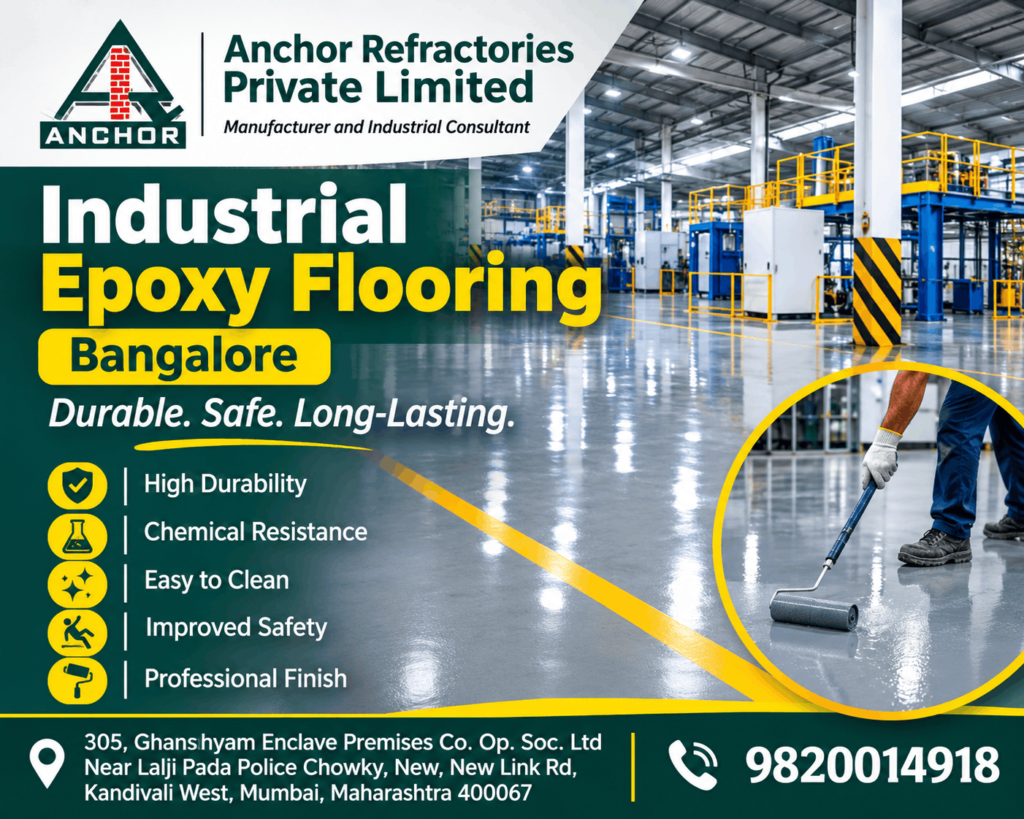
Industrial flooring plays an important role in maintaining safety, productivity, hygiene and operational efficiency in manufacturing facilities. Factories, warehouses, pharmaceutical units, automobile workshops and commercial industrial buildings require flooring that can withstand continuous movement, heavy equipment, chemical exposure and daily wear. Industrial Epoxy Flooring Bangalore.
Industrial Epoxy Flooring Bangalore is an increasingly relevant flooring solution for industrial facilities looking for durable, seamless and easy-to-maintain floor surfaces. Epoxy flooring creates a protective layer over concrete, helping improve surface performance while providing a clean and professional appearance.
Anchor Refractories Private Limited, a manufacturer and industrial consultant, understands the importance of selecting suitable industrial materials and flooring systems according to project requirements. Choosing the right Industrial Epoxy Flooring system involves evaluating floor conditions, operational loads, chemical exposure and long-term maintenance needs. Industrial Epoxy Flooring Bangalore.
In this guide, we explain the benefits, applications, types, installation process and important considerations when selecting an industrial epoxy flooring system in Bangalore.
What Is Industrial Epoxy Flooring?
Industrial epoxy flooring is a resin-based flooring system created by combining epoxy resin with a suitable hardener. Once mixed and applied correctly, these components undergo a chemical reaction and form a hard, durable and protective surface. Industrial Epoxy Flooring Bangalore.
Industrial Epoxy Flooring is commonly applied over prepared concrete floors in factories, warehouses, production units, laboratories and other industrial environments.
Depending on the application, epoxy flooring systems can include primers, self-levelling coatings, high-build coatings, epoxy mortars and protective topcoats.
The main purpose of an epoxy floor is to protect the underlying concrete while providing a functional surface suitable for specific industrial activities.
Why Choose Industrial Epoxy Flooring Bangalore for Industrial Facilities?
Bangalore is home to manufacturing companies, automobile industries, engineering units, logistics centres, electronics manufacturers and pharmaceutical facilities. These businesses require flooring solutions that support demanding operational conditions.
Industrial Epoxy Flooring Bangalore offers several advantages when the correct system is selected and installed over a properly prepared substrate.
1. Excellent Durability
Industrial floors experience continuous foot traffic, machinery movement, material handling and equipment operations. Ordinary concrete floors may gradually develop surface wear, dusting and deterioration.
A properly specified Industrial Epoxy Flooring system creates a tough protective layer that helps improve abrasion resistance and protects the concrete surface from routine industrial wear.
2. Chemical Resistance
Manufacturing facilities frequently handle oils, lubricants, cleaning agents, industrial chemicals and other substances.
Chemical-resistant epoxy systems can protect concrete against exposure to specified chemicals. However, chemical resistance depends on the resin formulation, concentration, temperature and duration of exposure.
Businesses should always select a system based on the actual chemicals used in their facility.
3. Seamless and Hygienic Surface
Traditional flooring materials may contain joints where dust, dirt and contaminants accumulate.
Industrial Epoxy Flooring creates a seamless surface when properly designed and applied. This makes cleaning easier and helps maintain better housekeeping standards.
It is particularly useful in laboratories, pharmaceutical facilities, food processing areas and clean production environments where suitable hygiene requirements must be maintained.
4. Easy Cleaning and Maintenance
Industrial facilities require flooring that can be cleaned without complicated maintenance procedures.
Epoxy flooring provides a smooth, non-porous finished surface that can generally be maintained using appropriate cleaning equipment and compatible detergents.
Regular cleaning helps preserve the appearance and performance of the floor.
5. Improved Workplace Safety
Floor safety is essential in warehouses, production areas and industrial workshops.
Industrial Epoxy Flooring systems can incorporate anti-slip aggregates and textured finishes to improve traction in areas exposed to water, oils or other liquids.
Different colours can also be used for designated walkways, production zones, storage areas and safety markings.
6. Professional Appearance
A well-finished industrial floor improves the overall appearance of a manufacturing facility.
Epoxy flooring is available in different colours and finishes, allowing businesses to create organised, professional-looking workspaces.
Types of Industrial Epoxy Flooring Systems
Different industrial environments require different flooring specifications. The right system depends on the condition of the concrete, traffic intensity, exposure conditions and performance expectations.
1. Epoxy Self-Levelling Flooring
Self-levelling epoxy flooring creates a smooth and uniform surface over a suitably prepared substrate.
It is commonly considered for laboratories, pharmaceutical units, electronics facilities, showrooms and manufacturing environments where a seamless finish is important. Industrial Epoxy Flooring Bangalore.
2. Heavy-Duty Epoxy Flooring
Heavy-duty epoxy flooring systems are designed for demanding industrial environments involving regular mechanical movement, material handling and heavier traffic.
Depending on the specification, epoxy mortar or high-build systems may be appropriate for manufacturing facilities and warehouses.
3. Chemical-Resistant Epoxy Flooring
Chemical-resistant epoxy systems are designed for facilities where floors may come into contact with specific chemicals, oils and industrial liquids.
The formulation should be selected after reviewing the chemical exposure conditions and the manufacturer’s chemical resistance data.
4. Anti-Slip Epoxy Flooring
Smooth epoxy floors can become slippery when wet or contaminated.
Anti-slip epoxy flooring incorporates suitable aggregates or textured finishes to improve traction. It is useful in workshops, production areas, loading zones and other locations where slip resistance is important. Industrial Epoxy Flooring Bangalore
5. ESD Epoxy Flooring
Electrostatic dissipative (ESD) epoxy flooring is designed for environments where controlling static electricity is essential.
It may be required in electronics manufacturing, specialised assembly units and selected laboratories.
ESD systems require suitable conductive components, grounding arrangements and electrical performance testing. Ordinary epoxy flooring should not be considered an ESD solution. Industrial Epoxy Flooring Bangalore.
Industrial Applications of Industrial Epoxy Flooring Bangalore
Industrial Epoxy Flooring Bangalore can be considered for several types of facilities depending on their operational and technical requirements.
Manufacturing and Production Units
Manufacturing facilities require floors that can withstand regular machinery movement, equipment operations and material handling.
A suitable epoxy system can protect the concrete surface and support easier cleaning.
Warehouses and Logistics Centres
Warehouses experience continuous forklift movement, pallet handling and heavy foot traffic.
Industrial Epoxy Flooring can help reduce concrete dusting, improve surface maintenance and create clearly defined operational zones.
Pharmaceutical and Healthcare Facilities
Pharmaceutical manufacturing environments require flooring that supports cleanliness and routine sanitation.
Seamless epoxy systems with suitable chemical resistance and hygiene-related specifications may be considered for selected production areas.
Automobile Workshops
Automobile workshops frequently deal with lubricants, oils, grease and mechanical equipment. Industrial Epoxy Flooring Bangalore.
A properly selected epoxy flooring system can improve floor protection and simplify routine cleaning.
Food Processing Industries
Food processing facilities require flooring designed around hygiene, cleaning methods, drainage and moisture exposure.
The selected system should also account for hot-water washing, thermal shock and slip-resistance requirements. In some demanding wet-processing environments, polyurethane cement flooring may be a more appropriate alternative. Industrial Epoxy Flooring Bangalore.
Electronics and Electrical Industries
Electronics facilities may require specialist flooring systems to control electrostatic discharge.
Industrial Epoxy Flooring with ESD properties can be considered when the system is specifically designed, installed and tested for the required electrical performance.
Industrial Epoxy Flooring Bangalore: Step-by-Step Installation Process
Proper installation is essential for achieving long-lasting flooring performance. Even high-quality epoxy materials may fail when the concrete surface is not prepared correctly.
The following steps explain a typical Industrial Epoxy Flooring installation process.
Step 1: Site Inspection and Floor Assessment
The first step involves inspecting the existing concrete floor.
The assessment should identify:
- Concrete strength and surface condition.
- Existing cracks, holes and damaged sections.
- Oil, grease and chemical contamination.
- Moisture conditions within the concrete.
- Floor level and drainage requirements.
- Expected machinery and traffic loads.
This assessment helps determine the appropriate flooring specification.
Step 2: Mechanical Surface Preparation
Surface preparation is one of the most important stages of epoxy flooring installation.
Diamond grinding, shot blasting or other suitable mechanical methods are used to remove weak surface layers, old coatings, cement laitance and contaminants.
The objective is to create a clean, sound and appropriately profiled surface that supports proper bonding.
Step 3: Crack and Surface Repair
Cracks, damaged concrete, holes and uneven sections should be repaired using compatible repair materials.
Structural movement joints should be assessed and treated appropriately rather than simply covered with rigid epoxy.
Step 4: Primer Application
A compatible epoxy primer is applied to the prepared substrate when required by the selected flooring system.
The primer helps establish adhesion between the concrete and subsequent epoxy layers.
Step 5: Epoxy Coating Application
The epoxy resin and hardener are mixed according to the manufacturer’s specified mixing ratio.
The material is then applied using suitable tools and techniques to achieve the required thickness and finish.
Depending on the project, multiple coats or a self-levelling layer may be required.
Step 6: Protective Topcoat and Final Inspection
A suitable protective topcoat may be applied to improve the required surface characteristics.
The completed floor should be inspected for coating thickness, uniformity, surface defects and other specified performance requirements.
The floor must be allowed to cure according to the product manufacturer’s instructions before being exposed to operational traffic.
Important Factors to Consider Before Choosing Industrial Epoxy Flooring Bangalore
Before selecting Industrial Epoxy Flooring Bangalore, businesses should evaluate several technical and operational factors.
1. Concrete Condition: The existing concrete must be sufficiently strong and properly prepared to support the selected flooring system.
2. Moisture Levels: Moisture vapour transmission can cause blistering or adhesion problems. Appropriate moisture testing and mitigation may be necessary.
3. Traffic Requirements: Forklift movement, machinery loads and pedestrian traffic influence the required flooring thickness and system selection.
4. Chemical Exposure: Select the resin system according to the actual chemicals, their concentrations and exposure duration.
5. Slip Resistance: The surface texture should match the safety requirements of the operating environment.
6. Flooring Thickness: Different applications require different coating thicknesses. The specification should be based on expected performance rather than appearance alone.
7. Installation and Curing Time: Production schedules should account for surface preparation, application and the manufacturer’s recommended curing period.
Common Industrial Epoxy Flooring Problems and How to Prevent Them
Although epoxy flooring provides several benefits, improper installation and unsuitable specifications can result in premature flooring failure.
Peeling and Delamination
Peeling can occur because of inadequate surface preparation, contamination, moisture or poor bonding.
Prevention: Mechanically prepare the substrate, remove contaminants and verify moisture conditions before application.
Bubbles and Blisters
Bubbles and blisters may develop because of moisture vapour transmission, trapped air or unsuitable application conditions.
Prevention: Conduct appropriate substrate testing and follow the selected system’s application guidelines.
Cracking
Rigid epoxy coatings can reflect cracks or movement in the underlying concrete.
Prevention: Repair cracks correctly and provide appropriate treatment for construction and movement joints.
Uneven Surface Finish
An uneven appearance may result from poor mixing, incorrect application thickness or unsuitable site conditions.
Prevention: Follow manufacturer specifications and use trained application personnel.
Slippery Flooring
A smooth epoxy surface may become slippery when exposed to water, oil or other liquids.
Prevention: Specify an appropriate textured or anti-slip finish according to the operating environment.
Why Choose Anchor Refractories Private Limited for Industrial Flooring Consultation?
Selecting a suitable industrial flooring system requires technical understanding of materials, substrate conditions and industrial operating requirements.
Anchor Refractories Private Limited is a manufacturer and industrial consultant focused on industrial requirements and material-related solutions.
When evaluating Industrial Epoxy Flooring Bangalore, businesses should consider a flooring system that matches their facility’s operational conditions rather than choosing a product based only on initial cost or appearance.
Important considerations include:
- Understanding the industrial application and site requirements.
- Selecting suitable flooring materials and specifications.
- Evaluating chemical and mechanical exposure.
- Considering concrete preparation and moisture conditions.
- Reviewing long-term durability and maintenance requirements.
- Choosing appropriate technical solutions for individual industrial environments.
Anchor Refractories Private Limited encourages businesses to assess their flooring requirements carefully and select appropriate industrial solutions based on project-specific conditions.
Benefits of Investing in Quality Industrial Epoxy Flooring
Investing in a properly specified Industrial Epoxy Flooring system can offer long-term operational benefits.
These include:
- Better protection for concrete floors.
- Reduced concrete dusting.
- Improved cleaning and maintenance.
- Better resistance to specified chemicals.
- Improved appearance of industrial facilities.
- Customisable colours and surface textures.
- Support for organised and safer workspaces.
The overall value depends on the quality of materials, correct system selection, installation workmanship and regular maintenance.
Conclusion
Choosing the right Industrial Epoxy Flooring system is an important decision for businesses that want durable, functional and easy-to-maintain industrial floors.
From manufacturing units and warehouses to automobile workshops and pharmaceutical facilities, epoxy flooring can provide a protective and seamless surface when the system is correctly designed for the operating environment.
For businesses exploring Industrial Epoxy Flooring Bangalore, careful evaluation of concrete conditions, chemical exposure, traffic requirements, moisture levels and safety specifications is essential.
Anchor Refractories Private Limited, a manufacturer and industrial consultant, understands the importance of selecting appropriate industrial materials and technical solutions. Contact the company to discuss your industrial requirements and explore suitable flooring-related solutions for your facility.
Frequently Asked Questions (FAQs)
1. What is Industrial Epoxy Flooring?
Industrial epoxy flooring is a resin-based flooring system applied over prepared concrete surfaces to create a durable, protective and seamless finish for industrial environments.
2. Is Industrial Epoxy Flooring suitable for factories?
Yes. A properly selected epoxy flooring system can be suitable for factories, manufacturing units, workshops and warehouses, depending on traffic, chemical exposure and operating conditions.
3. How long does industrial epoxy flooring last?
Its service life depends on the material quality, coating thickness, substrate condition, installation quality, traffic intensity and maintenance practices. There is no single lifespan applicable to every industrial floor.
4. Is epoxy flooring resistant to chemicals?
Many epoxy systems offer resistance to specific chemicals, oils and industrial liquids. However, chemical compatibility should always be verified against the manufacturer’s technical data.
5. Can epoxy flooring be applied over old concrete?
Yes. Existing concrete can receive epoxy flooring if it is structurally sound and properly prepared. Cracks, contamination, moisture and damaged areas must be assessed before installation.
6. Is epoxy flooring suitable for warehouses in Bangalore?
Yes. Suitable epoxy systems can be used in warehouses to protect concrete surfaces from routine traffic, reduce dusting and simplify cleaning.
7. Is anti-slip epoxy flooring available?
Yes. Anti-slip finishes can be created using suitable aggregates and textured coatings. The selected finish should meet the area’s safety and cleaning requirements.
8. How do I choose the right industrial epoxy flooring system?
Consider your concrete condition, machinery loads, traffic intensity, chemical exposure, moisture levels, slip resistance and maintenance requirements before selecting a system.
9. Can epoxy flooring be used in pharmaceutical industries?
Yes. Suitable seamless epoxy systems can be used in selected pharmaceutical production environments where cleanability, chemical resistance and hygiene requirements are important.
10. Where can I discuss industrial flooring requirements in Bangalore?
You can contact Anchor Refractories Private Limited to discuss your industrial material and flooring-related requirements and explore suitable technical solutions.