
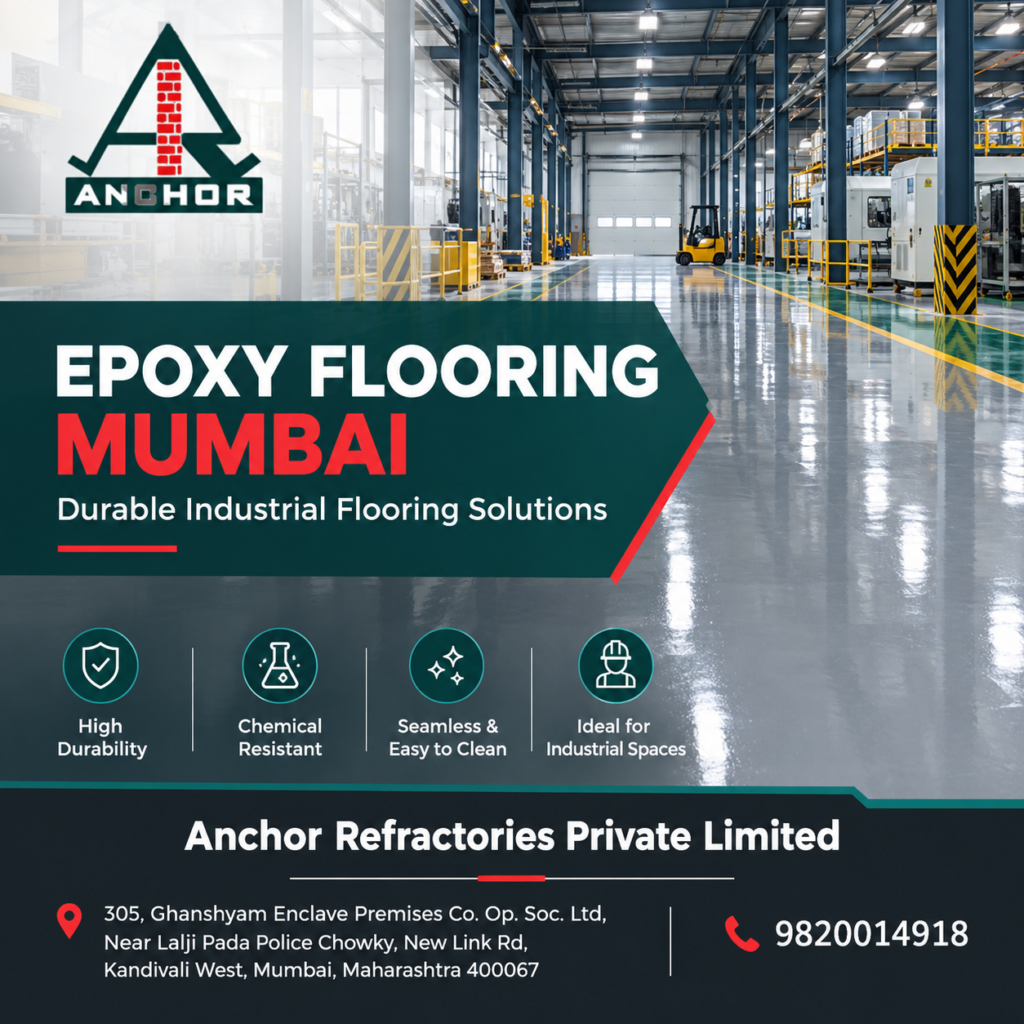
Modern industries need flooring that can withstand heavy traffic, machinery movement, chemical spills, and everyday wear. Epoxy Flooring Mumbai is a practical solution for businesses looking for a durable, seamless, and easy-to-maintain floor surface. From manufacturing units and warehouses to commercial facilities, epoxy flooring helps protect concrete floors while creating a professional working environment.
Anchor Refractories Private Limited is a manufacturer and industrial consultant focused on industrial requirements and practical solutions. Choosing the right flooring system begins with understanding your facility, operating conditions, and long-term performance needs.
What Is Epoxy Flooring Mumbai?
Epoxy flooring is a protective floor system created by applying epoxy resin and a suitable hardener over a properly prepared substrate, usually concrete. Once cured, the coating forms a strong, seamless surface that can resist abrasion, stains, and many industrial chemicals, depending on the selected product.
Businesses searching for Epoxy Flooring Mumbai often require flooring that combines durability, cleanliness, and operational efficiency. The right system depends on the floor’s existing condition, expected loads, chemical exposure, moisture levels, and required finish.
Unlike untreated concrete, an appropriate epoxy coating can help reduce surface dust, simplify routine cleaning, and protect the underlying floor from everyday industrial wear.
Benefits of Epoxy Flooring Mumbai for Industrial Facilities
Selecting a suitable flooring system can improve the usability and maintenance of industrial spaces. Here are the major benefits to consider.
1. Excellent Durability and Wear Resistance
Industrial floors experience constant movement from workers, equipment, pallet trucks, and other vehicles. A correctly specified epoxy system can provide strong resistance to abrasion and everyday wear.
For facilities evaluating Epoxy Flooring Mumbai, durability is an important consideration because repeated floor repairs can disrupt operations and increase maintenance expenses.
2. Chemical and Oil Resistance
Factories and workshops may encounter oils, lubricants, cleaning agents, and chemical spills. Depending on the formulation, epoxy coatings can protect concrete against many of these substances.
Before selecting Epoxy Flooring Mumbai, businesses should identify the chemicals used at their premises and verify compatibility with the proposed coating system.
3. Seamless and Easy-to-Clean Surfaces
Epoxy flooring creates a continuous surface without the numerous grout joints associated with conventional tiled floors. This can simplify cleaning and help reduce dust accumulation when the coating is properly installed and maintained.
Facilities that prioritize cleanliness may benefit from Epoxy Flooring Mumbai, particularly in production areas, workshops, laboratories, and suitable processing environments.
4. Improved Workplace Safety
Floor safety depends on appropriate surface texture, housekeeping, lighting, and clearly marked work areas. Anti-slip additives and designated safety markings can be incorporated into suitable flooring systems.
When considering Epoxy Flooring Mumbai, select a finish that matches the site’s actual conditions, especially where water, oils, or other liquids may reach the floor.
5. Professional Appearance
A consistent floor finish can improve the appearance of factories, showrooms, warehouses, and commercial workspaces. Different colours and finishes may also help distinguish work zones, walkways, and storage areas.
Businesses investing in Epoxy Flooring Mumbai can select a finish according to operational requirements and the appearance they want to achieve.
Types of Epoxy Flooring Mumbai Businesses Can Consider
Different industries require different flooring properties. Choosing the correct system is essential for long-term performance.
Self-Leveling Epoxy Flooring
Self-leveling epoxy spreads across a prepared surface to create a smooth and uniform finish. It is suitable for selected manufacturing areas, laboratories, and commercial environments where a level, easy-to-clean surface is important.
Heavy-Duty Epoxy Flooring
Heavy-duty systems are designed for demanding environments where the floor experiences substantial traffic, abrasion, or impact. The required thickness and formulation depend on the expected loads and operating conditions.
For these applications, Epoxy Flooring Mumbai projects should begin with a technical assessment rather than selecting a coating based only on appearance or price.
Anti-Slip Epoxy Flooring
Anti-slip systems incorporate suitable aggregates or textures to improve traction. They can be considered for ramps, selected production areas, and locations where slippery conditions may occur.
The appropriate texture should balance traction with cleaning requirements.
Anti-Static Epoxy Flooring
Certain industrial and electronic environments require control of electrostatic discharge. Specialized conductive or dissipative flooring systems may be suitable when designed and installed with compatible grounding arrangements.
Standard epoxy flooring should not automatically be considered anti-static. Confirm the required electrical performance before selecting a system.
Chemical-Resistant Epoxy Flooring
Chemical-resistant formulations are designed for environments where the floor may contact specific corrosive or aggressive substances. Chemical compatibility, exposure duration, temperature, and concentration must be assessed before installation.
Applications of Epoxy Flooring Mumbai Across Industries
Epoxy flooring is used in many industrial and commercial environments, provided the selected system is appropriate for the application.
Manufacturing Units and Factories
Manufacturing facilities need floors that can handle regular movement, equipment use, and production-related wear. A suitable coating can help protect concrete and support easier housekeeping.
Warehouses and Logistics Facilities
Warehouses experience frequent movement of goods, storage equipment, and vehicles. Industrial floor coatings can improve surface consistency and help reduce concrete dust when correctly specified.
Pharmaceutical and Laboratory Facilities
Selected laboratories and pharmaceutical environments require smooth, cleanable surfaces. The flooring system must meet the facility’s hygiene, chemical resistance, and regulatory requirements.
Automotive Workshops and Service Centres
Automotive facilities may encounter lubricants, oils, and vehicle-related wear. A suitable epoxy coating can improve cleanability and provide protection against compatible substances.
Food Processing Facilities
Food production areas often require floors that are easy to clean and resistant to the chemicals used during sanitation. The selected system should meet applicable hygiene requirements and withstand the facility’s cleaning procedures.
Commercial Buildings and Showrooms
Epoxy coatings may also be suitable for selected showrooms, commercial workspaces, utility rooms, and other areas where a durable, attractive finish is required.
When comparing Epoxy Flooring Mumbai options, businesses should assess the specific demands of each area instead of choosing one system for every part of the building.
Epoxy Flooring Mumbai: Understanding the Installation Process
Proper installation is essential for achieving reliable coating performance. Even a high-quality material may fail prematurely if the substrate is unsuitable or preparation is inadequate.
Step 1: Site Inspection and Floor Assessment
The existing concrete floor should be inspected for cracks, weak areas, contamination, unevenness, and moisture-related problems. The intended use of the facility should also be discussed.
Step 2: Surface Preparation
Grinding, shot blasting, or another suitable preparation method may be required to remove weak material and create an appropriate bonding profile. Oil, grease, dust, and other contaminants must be addressed.
Step 3: Crack Repair and Priming
Cracks and surface defects should be repaired using compatible materials. A suitable primer is then applied according to the selected system’s technical instructions.
Step 4: Epoxy Application
The resin and hardener are mixed in the specified proportions and applied using the recommended method. Application thickness, environmental conditions, and working time must be controlled.
Step 5: Protective Topcoat and Curing
Where required, a compatible topcoat is applied to provide the desired finish and additional protection. The floor must be allowed to cure according to the manufacturer’s instructions before traffic resumes.
A professional approach to Epoxy Flooring Mumbai includes inspection, material selection, careful preparation, controlled application, and final quality checks.
Factors Affecting Epoxy Flooring Mumbai Cost
The cost of an epoxy flooring project varies according to the site and the performance requirements. A reliable quotation should consider the following factors:
- Floor area: The total square footage affects material quantities and labour requirements.
- Existing floor condition: Damaged or contaminated concrete may need additional preparation and repairs.
- Coating thickness: Thicker systems generally require more material and labour.
- Type of epoxy: Self-leveling, heavy-duty, anti-slip, and chemical-resistant systems have different specifications.
- Moisture conditions: Moisture testing and mitigation may be necessary before application.
- Site accessibility: Equipment access, working hours, and operational restrictions may influence project costs.
- Curing and downtime: The time available for installation and curing can affect scheduling and the choice of materials.
Businesses seeking Epoxy Flooring Mumbai should request a site-specific quotation with the proposed coating system, preparation requirements, coverage, thickness, and curing conditions clearly stated.
Why Choose Anchor Refractories Private Limited?
Choosing an industrial flooring solution requires more than comparing coating prices. Businesses should understand their operating environment and select materials that meet the actual demands of the facility.
Anchor Refractories Private Limited is a manufacturer and industrial consultant. For industrial projects, a careful assessment of application requirements, material suitability, and expected performance can help businesses make informed decisions.
When exploring Epoxy Flooring Mumbai, consider the following before finalizing your project:
- Assess the condition and suitability of the existing substrate.
- Identify the expected traffic, equipment loads, and chemical exposure.
- Select a coating system compatible with the facility’s operational requirements.
- Confirm the installation method and surface preparation standards.
- Review the manufacturer’s technical data and maintenance recommendations.
- Plan installation and curing to minimize disruption to business operations.
The right flooring specification should balance performance, safety, maintenance, and project cost.
Maintenance Tips for Long-Lasting Epoxy Floors
Regular maintenance helps preserve the appearance and performance of an epoxy floor.
- Remove dust and loose debris through routine sweeping or vacuuming.
- Clean spills promptly using cleaning products compatible with the coating.
- Avoid dragging heavy equipment across the floor without suitable protection.
- Inspect high-traffic areas for scratches, impact damage, and wear.
- Repair damaged sections before deterioration spreads.
- Follow the flooring manufacturer’s maintenance and chemical-handling recommendations.
A well-maintained system can provide dependable service, although its actual lifespan depends on installation quality, traffic, exposure conditions, and maintenance.
Frequently Asked Questions About Epoxy Flooring Mumbai
Is epoxy flooring suitable for industrial use?
Yes. Appropriate epoxy systems can be used in factories, warehouses, workshops, and selected processing facilities. The correct specification depends on traffic, loads, chemicals, substrate condition, and operating conditions.
How long does epoxy flooring take to cure?
Curing time depends on the product formulation, coating thickness, temperature, humidity, and site conditions. Light foot traffic and full operational use may require different waiting periods. Always follow the manufacturer’s instructions.
Is epoxy flooring resistant to chemicals?
Many epoxy formulations resist specific chemicals, but no single system is suitable for every chemical or exposure condition. Check the manufacturer’s compatibility information before installation.
Can epoxy flooring be applied to an existing concrete floor?
Yes, provided the concrete is suitable and properly prepared. Weak concrete, excessive moisture, contamination, and structural defects may require corrective work before coating.
What determines the cost of epoxy flooring in Mumbai?
The price depends on the area, surface condition, coating type, thickness, material selection, preparation work, and site requirements. A site inspection helps establish a more accurate estimate.
How can businesses select the right epoxy flooring system?
Start by identifying the facility’s operational needs, including load requirements, chemical exposure, slip resistance, cleaning procedures, and expected downtime. Consult qualified flooring professionals and review the proposed product specifications.
Conclusion: Choose the Right Epoxy Flooring Mumbai Solution
Industrial flooring plays an important role in protecting concrete surfaces, supporting workplace cleanliness, and maintaining efficient operations. The right coating system can provide durability, chemical resistance, easier maintenance, and a professional finish when correctly specified and installed.
Anchor Refractories Private Limited, a manufacturer and industrial consultant, encourages businesses to evaluate their flooring requirements carefully before choosing a solution. If your facility is planning a flooring upgrade, assess the substrate, operating conditions, and long-term maintenance needs before finalizing the specification.
Explore suitable Epoxy Flooring Mumbai solutions for your industrial or commercial project and prioritize performance, quality, and long-term value.