
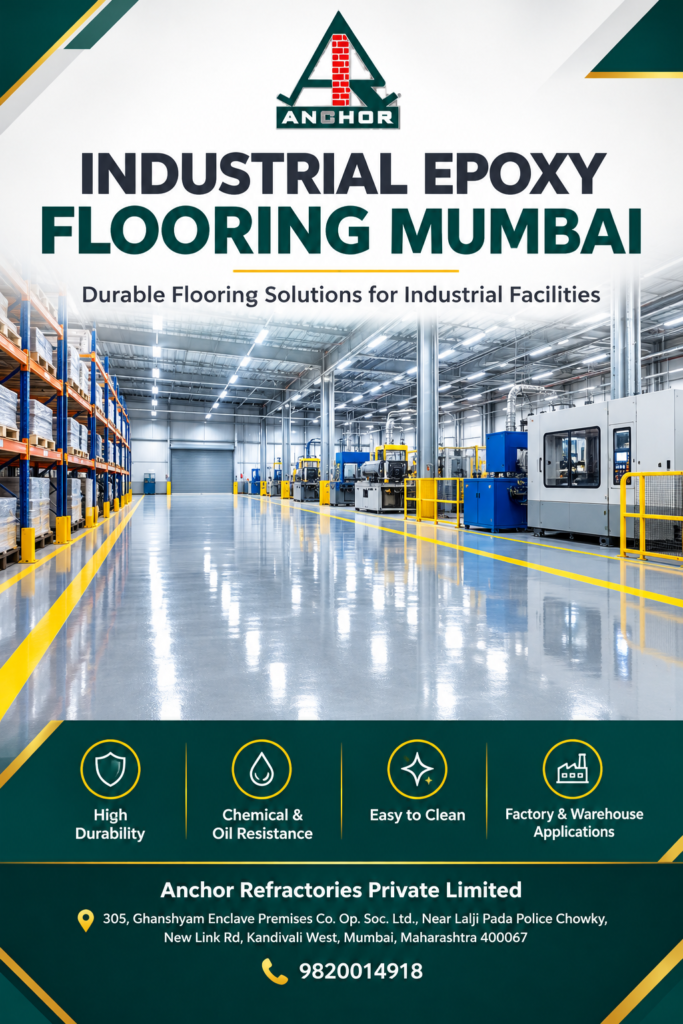
Industrial flooring plays an important role in maintaining safety, cleanliness, durability, and operational efficiency in factories and commercial facilities. Businesses searching for Industrial Epoxy Flooring Mumbai need a flooring solution that can withstand regular industrial traffic, machinery movement, abrasion, and exposure to selected chemicals.
Anchor Refractories Private Limited is a manufacturer and industrial consultant focused on industrial requirements. Selecting the appropriate flooring system requires careful consideration of the concrete substrate, operating conditions, load requirements, and maintenance expectations.
In this guide, we explain the benefits, types, applications, installation process, and selection criteria for industrial epoxy flooring to help businesses make informed decisions.
What Is Industrial Epoxy Flooring Mumbai?
Industrial Epoxy Flooring Mumbai refers to epoxy resin-based flooring systems applied over properly prepared concrete surfaces to improve surface protection, durability, and ease of maintenance. These systems typically combine epoxy resin and a compatible hardener to create a bonded, hardened surface.
Unlike conventional concrete finishes, industrial epoxy coatings can provide a seamless finish with improved resistance to abrasion, oil spills, and selected chemicals, depending on the product specification.
Industrial facilities in Mumbai and surrounding industrial areas can consider epoxy flooring for manufacturing units, warehouses, workshops, laboratories, and production areas where floor performance is important.
The correct system depends on the condition of the existing floor, the type of industrial activity, traffic intensity, moisture conditions, and the required coating thickness.
Benefits of Industrial Epoxy Flooring Mumbai
Choosing the right Industrial Epoxy Flooring Mumbai solution can help businesses protect concrete floors and improve workplace functionality.
1. Improved Floor Durability
Industrial floors experience constant movement from workers, equipment, carts, and machinery. A suitably specified epoxy system can improve resistance to surface wear and abrasion.
For facilities with heavy machinery or forklift traffic, the flooring system must be selected according to the actual load and operating conditions.
2. Chemical and Oil Resistance
Manufacturing plants, engineering workshops, and processing facilities may experience oil spills or contact with industrial chemicals.
Chemical-resistant epoxy systems can help protect concrete surfaces against specified substances. Always verify the manufacturer’s chemical-resistance data before choosing a coating for demanding environments.
3. Easy Cleaning and Maintenance
A properly installed epoxy floor creates a smooth, relatively seamless surface that is easier to clean than unfinished concrete.
This can help reduce dust accumulation and simplify routine maintenance in warehouses, production facilities, and selected clean working environments.
4. Better Workplace Organization
Industrial epoxy flooring is available in different colours and finishes. Businesses may use contrasting colours to distinguish work areas, pedestrian walkways, equipment zones, and storage sections. Industrial Epoxy Flooring Mumbai.
Floor markings should be designed according to the facility’s safety procedures and operational requirements.
5. Customizable Flooring Systems
Different industries require different flooring characteristics. Options may include self-leveling epoxy, heavy-duty epoxy screeds, anti-slip finishes, and electrostatic dissipative systems.
The best choice depends on the intended application rather than appearance alone.
Types of Industrial Epoxy Flooring Mumbai Businesses Can Consider
Before selecting Industrial Epoxy Flooring Mumbai, businesses should understand the common flooring systems available.
Self-Leveling Epoxy Flooring
Self-leveling epoxy creates a smooth, uniform finish when applied to a suitably prepared substrate. It is commonly considered for production areas, laboratories, and commercial-industrial interiors where a clean appearance is desirable.
Heavy-Duty Epoxy Flooring
Heavy-duty epoxy systems are designed for demanding environments. Depending on the system specification, they may provide enhanced resistance to abrasion, impact, and mechanical wear.
Factories and workshops should assess machinery loads, traffic frequency, and impact exposure before installation.
Anti-Slip Epoxy Flooring. Industrial Epoxy Flooring Mumbai
Anti-slip epoxy flooring incorporates a suitable texture or aggregate to improve traction in areas where smooth surfaces may create slip risks.
The level of slip resistance should be appropriate for the expected conditions, including water, oil, cleaning chemicals, and pedestrian traffic.
Chemical-Resistant Epoxy Flooring
Chemical-resistant flooring is designed for environments where floors may come into contact with specified chemicals. The resin system must be compatible with the substances, concentrations, temperatures, and exposure durations involved.
This option may be relevant to chemical processing, industrial maintenance, and selected manufacturing operations.
Anti-Static and ESD Flooring
Electrostatic dissipative (ESD) flooring is used in applications where controlling static electricity is important, including certain electronics manufacturing and technical environments.
These systems require suitable design, installation, grounding, and testing to meet the facility’s electrical requirements.
Applications of Industrial Epoxy Flooring Mumbai
Industrial Epoxy Flooring Mumbai can be considered for a range of industrial and commercial applications.
Factory and Manufacturing Units
Factories require floors that support daily operations, equipment movement, and regular cleaning. The flooring specification should reflect the production process and the expected mechanical and chemical exposure.
Warehouses and Logistics Centres
Warehouses experience frequent movement of pallets, trolleys, and forklifts. Properly selected epoxy coatings can protect suitable concrete surfaces and support organized storage and material handling.
Pharmaceutical and Laboratory Facilities
Certain laboratories and pharmaceutical areas require smooth, cleanable flooring with carefully specified chemical resistance. The complete flooring system must meet the facility’s hygiene and regulatory requirements.
Automotive Workshops
Automotive workshops may benefit from flooring designed to withstand vehicle traffic, grease, oils, and routine cleaning. Chemical compatibility and slip resistance should be evaluated before selecting the coating.
Food Processing Areas
Food processing environments may require hygienic, easily cleanable flooring systems. The selected materials and installation details should meet applicable food-safety, cleaning, drainage, and operational requirements.
Industrial Epoxy Flooring Mumbai: Installation Process
A reliable flooring result depends on appropriate materials, skilled application, and correct preparation.
Step 1: Site Inspection and Assessment
The existing concrete floor should be inspected for cracks, surface deterioration, unevenness, contamination, and moisture-related concerns.
The contractor or technical consultant should also understand the operating environment and the required performance characteristics.
Step 2: Surface Preparation
Surface preparation is one of the most important stages of epoxy flooring installation. Depending on the substrate, mechanical grinding or shot blasting may be required to remove contaminants and create a suitable surface profile.
Cracks, damaged areas, and other defects should be repaired using compatible materials.
Step 3: Primer Application
A compatible primer may be applied to improve adhesion between the prepared concrete and the flooring system. Product selection should account for substrate conditions and manufacturer recommendations.
Step 4: Epoxy Coating Application
The specified epoxy system is mixed and applied according to the manufacturer’s instructions. Application thickness, mixing ratios, temperature, and working time must be controlled carefully.
Step 5: Finishing and Curing
The final coating or topcoat is applied as required by the system design. The floor must then be protected during the prescribed curing period before pedestrian or vehicle traffic is allowed.
Actual installation and curing times vary by product, site conditions, and coating thickness.
How to Choose the Right Industrial Epoxy Flooring Mumbai Solution
When comparing Industrial Epoxy Flooring Mumbai options, businesses should evaluate several factors.
- Floor condition: Check the strength, moisture condition, cracks, and surface profile of the concrete.
- Traffic requirements: Assess pedestrian movement, forklift traffic, machinery loads, and impact exposure.
- Chemical exposure: Identify the chemicals used at the facility and confirm compatibility with the proposed system.
- Safety requirements: Consider slip resistance, electrical properties, cleaning procedures, and relevant workplace standards.
- Coating thickness: Select the thickness and system based on the required performance, not price alone.
- Maintenance requirements: Review cleaning methods, inspection schedules, and future repair needs.
- Installation downtime: Coordinate the project with production schedules and the manufacturer’s curing requirements.
A site-specific assessment helps prevent unsuitable specifications and reduces the risk of premature coating failure.
Industrial Epoxy Flooring Mumbai: Factors Affecting Cost
The cost of Industrial Epoxy Flooring Mumbai varies according to the project requirements. An accurate quotation should account for:
- Total floor area and layout.
- Existing concrete condition and preparation work.
- Required coating type and thickness.
- Crack repair, leveling, and moisture mitigation.
- Chemical resistance or anti-slip requirements.
- Material specifications and application labour.
- Site access, operational restrictions, and installation schedule.
Businesses should request a detailed quotation that clearly identifies the proposed flooring system, preparation work, coating thickness, and exclusions. Comparing quotations on a like-for-like basis is more useful than choosing a contractor solely on the lowest initial price.
Why Consider Anchor Refractories Private Limited?
Anchor Refractories Private Limited is a manufacturer and industrial consultant. For industrial projects, understanding the operating environment and technical requirements is an important starting point when evaluating flooring and protective surface solutions.
Businesses should discuss their facility’s requirements, including load conditions, chemical exposure, concrete condition, and expected service performance, before finalizing a flooring specification.
For any proposed epoxy flooring project, confirm the exact products, installation capabilities, technical specifications, and service scope directly with the company before making a purchasing decision.
Frequently Asked Questions
1. What is industrial epoxy flooring used for?
Industrial epoxy flooring is used to protect suitable concrete floors in factories, warehouses, workshops, laboratories, and other facilities that require durable, easy-to-clean surfaces.
2. Is epoxy flooring suitable for heavy machinery?
It can be suitable when the complete floor system and underlying concrete are designed for the expected loads. Heavy machinery, impact, vibration, and concentrated loads require a proper technical assessment.
3. How long does industrial epoxy flooring last?
Service life depends on the coating system, installation quality, substrate condition, traffic, chemical exposure, and maintenance. There is no single lifespan that applies to every industrial floor.
4. Can epoxy flooring resist chemicals?
Some epoxy systems offer resistance to specified chemicals. Suitability must be confirmed using the manufacturer’s technical data and the facility’s actual exposure conditions.
5. How do I select industrial epoxy flooring in Mumbai?
Start by evaluating the concrete floor, operational loads, chemical exposure, safety needs, coating thickness, and available installation downtime. Request a written specification and detailed quotation before proceeding.
Conclusion
Industrial Epoxy Flooring Mumbai can be a practical option for businesses seeking to improve concrete floor protection, cleanability, and operational performance. The right solution depends on the facility’s specific needs, from heavy-duty manufacturing floors to smooth warehouse surfaces and specialized chemical-resistant applications.
By evaluating the substrate, selecting a compatible flooring system, and following proper installation and curing procedures, businesses can make a more informed long-term flooring investment.
Anchor Refractories Private Limited serves as a manufacturer and industrial consultant. Contact the company to discuss your industrial requirements and confirm whether its available products and technical services are suitable for your project.